What Is an MBBR (Moving Bed Biofilm Reactor)?
One of the biggest challenges facing industrial facilities and local governments is ensuring highly efficient wastewater treatment within limited space. Traditional activated sludge systems may sometimes struggle to handle sudden spikes in pollution loads, or there may simply be no room for expansion at the facility. This is precisely where one of the most innovative solutions in the modern wastewater treatment world comes into play: the MBBR (Moving Bed Biofilm Reactor).
So, what is MBBR, how does the system work, and what benefits does it offer your facility? Let’s take a closer look at this smart system that is redefining standards in environmental technology.
What Is MBBR (Moving Bed Biofilm Reactor)?
MBBR is a biological wastewater treatment technology that combines the strongest aspects of the traditional activated sludge process with fixed-film (biofilm) systems under a single umbrella.
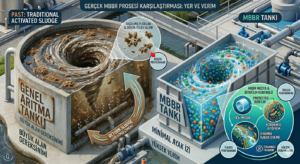
In this system, rather than remaining freely suspended in the water, microorganisms attach to the surface of specially designed plastic carriers (biofilm media) and multiply there. Thousands of these small media particles, placed inside the tank, remain in constant motion thanks to aeration or mechanical mixing.
How Does the MBBR System Work? (Operating Principle)
At the heart of the MBBR system are the MBBR media, which are made of high-density polyethylene (HDPE) and have a density very close to that of water (0.95–0.98 g/cm³). The basic operational steps of the system are as follows:
Biofilm Formation: When wastewater enters the reactor, microorganisms begin to attach to the protected pores on the inner and outer surfaces of the media, forming a protective biofilm layer.
Continuous Movement and Oxygen Integration: Oxygen supplied from diffusers (air blowers) at the bottom of the tank enables bacterial respiration while keeping the media in a state of continuous, chaotic movement within the tank.
Breakdown of Organic Matter: Organic pollutants (BOD and COD) in the wastewater come into contact with these constantly moving bacteria. The bacteria consume the pollutants as food, thereby purifying the water.
Self-Cleaning Dynamic Structure: Over time, the aging and thickening biofilm layer naturally breaks apart due to the media colliding with each other and is removed from the system. It is immediately replaced by a new, younger, active, and efficient biofilm layer. This prevents clogging issues.
Why MBBR? Key Advantages of the Technology
Compared to traditional treatment methods, MBBR technology offers tremendous advantages in terms of operating and investment costs:
Compact Design (Reduced Space Requirements): MBBR media provide a vast surface area ranging from 500 to 5,500 $m^2$ per cubic meter. As a result, the same treatment efficiency can be achieved in much smaller reactors instead of the massive tank volumes required by traditional systems.
High Resistance to Shock Loads: In industrial facilities, sudden increases in flow rate or fluctuations in chemical contamination (shock loads) can cripple biological treatment. The biofilm structure in MBBR is extremely resilient to such fluctuations, and the system quickly returns to its original stability.
Easy Capacity Expansion (Retrofit): If you have an existing activated sludge plant and your capacity is insufficient, there is no need to build a new reinforced concrete tank. You can easily increase capacity by simply adding MBBR media and appropriate support elements inside the existing tank.
Low Maintenance and Operational Ease: MBBR systems do not require a sludge recirculation (RAS) line. The system operates largely autonomously, requiring minimal operator intervention, and chronic operational issues such as sludge bulking do not occur.
Technical Specifications of MBBR Systems
The key parameters considered during the design phase and standard MBBR criteria are as follows:
Parameter / Feature General Values / Standards
Media Material HDPE (High-Density Polyethylene)
Media Density 0.95 – 0.98 g/cm³
Surface Area Covered 500 – 5,500 $m^2/m^3$
Tank Fill Ratio (Fill Ratio) 30% – 70% (Optimized as needed)
Energy Consumption Approximately 0.3 – 0.5 kWh/$m^3$ of treatment
Treatment Efficiency High BOD, COD, and Nitrification (Nitrogen Removal)
In Which Sectors Is MBBR Technology Used?
Thanks to its flexible structure and high efficiency, it is reliably preferred for the treatment of both domestic and challenging industrial wastewater:
Food, Dairy, and Beverage Industry: Efficient treatment of wastewater containing high organic loads.
Textile and Dyeing Plants: Management of chemical loads and color removal processes.
Chemical and Pharmaceutical Industries: Treatment of wastewater with variable characteristics that is susceptible to toxic effects.
Pulp and Cellulose Production: Management of high-volume, fibrous wastewater.
Municipal and Portable Treatment Systems: Container-type mobile treatment solutions for residential areas, hotels, or construction sites.